Author: Africa Center

Author Archive 22 Posts

Happy Holidays? (Dec 2021)

*|MC:SUBJECT|*
Logo

Happy Holidays?

As we are entering what has been dubbed the ‘festive season’ we at the Africa Center have been reflecting on what this season means for our community.
Despite the fact that it has become highly commercialized, Christmas is still widely known as the Christian celebration of the birth of Jesus Christ (despite the fact that he was born in June, but that is a story for another day). Hence, as a celebration and festive season it is closely linked to the Christian religion.

As a Center that is highly invested in doing decolonial work in terms of anti-racist work in Hong Kong and Asia at large it can often be difficult to separate Christianity from its brutal entry into most of the African continent through missionaries who in many cases paved the road for colonialists, or in some cases where in fact the colonialists themselves.

However, there is more to the history of Christianity on the African continent than colonialism. The most obvious example, that is unfortunately not well known is the long and strong history of orthodox Christianity in the eastern horn of Africa, especially in Ethiopia and Eritrea, where churches date back as far as the 4th century.

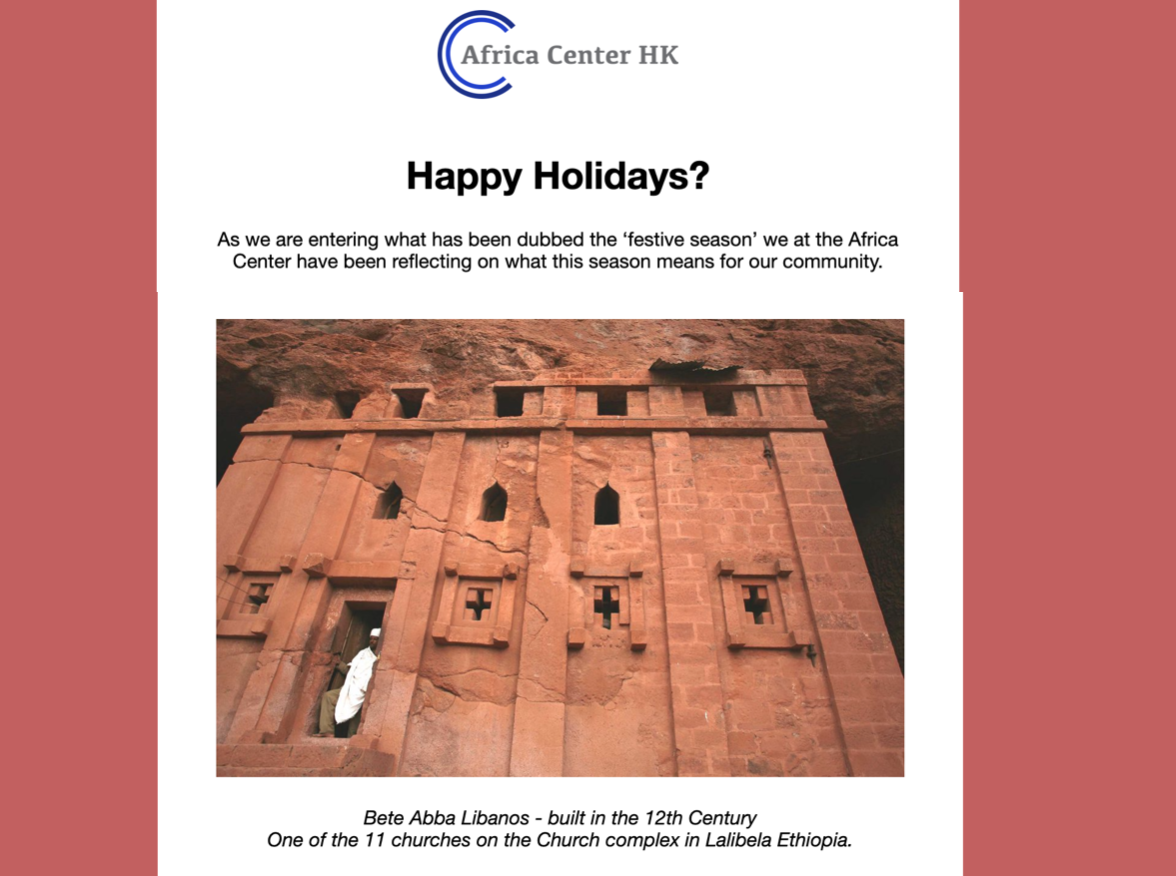
Bete Abba Libanos – built in the 12th Century
One of the 11 churches on the Church complex in Lalibela Ethiopia.

In the above picture you see one of the 11 churches found on the Lalibela Church complex in Lalibela, Ethiopia. Built in the 12th century these are not the oldest churches on the African continent, however, they are the most famous because of how they were built. These churches were carved out from volcanic rock found in the region. This means the churches were rather shaped out from the rock than built up – this is the only place in the world where we find this kind of top to bottom creation of structures making them so famous.

Despite these churches in Lalibela, we find other ancient, orthodox churches in other parts of Africa. The oldest known church on the African continent is in Egypt – The Monastery of Saint Anthony that was built around 356A.D.

Oldest Churches in Africa

So what does all of this mean for us?
We do not wish to erase the ills of that have been perpetrated in the name of Christianity on the African continent. However, in the spirit of trying to reclaim and understand our different histories we can also not erase that Christianity has been an important religion on the African continent in the past and continues to be one today.

In this spirit, we wish you all a good festive season in which we make an active effort to understand the festivals that we partake in.

Speaking of celebrations, as the year is coming to an end, we invite you to our end of year party that will be held in the true spirit of Afro-Asian Fusion!

As always we are always at the Africa Center in Tsim Sha Tsui doing the work to Rebrand Blackness in Hong Kong and beyond. Come and join us for our events that are open to the public.

Upcoming Events


This email was sent to *|EMAIL|*
why did I get this?    unsubscribe from this list    update subscription preferences
*|LIST:ADDRESSLINE|*

*|REWARDS|*

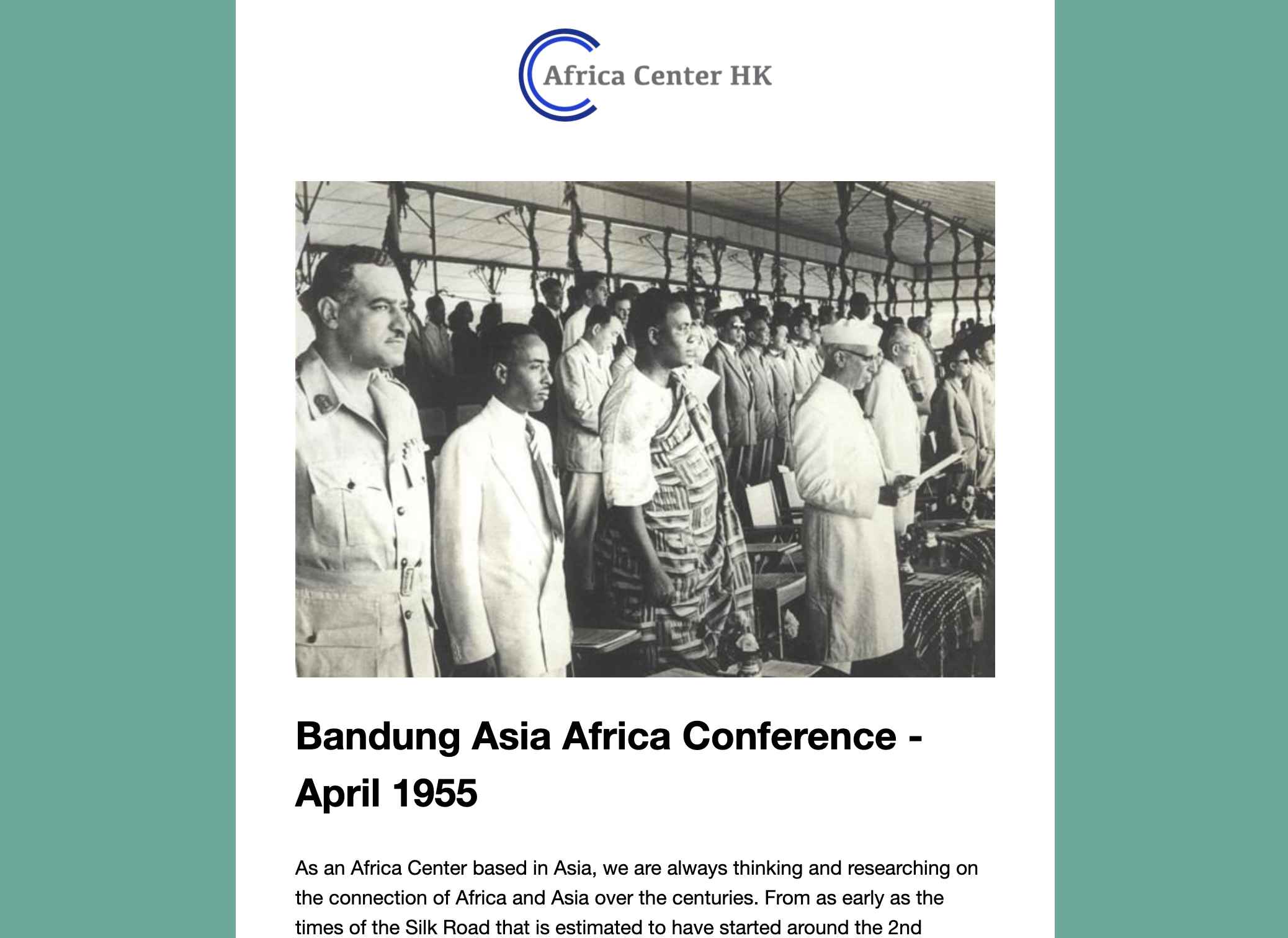
From The Bandung Conference To Today (Nov 2021)

*|MC:SUBJECT|*
Logo
More on the Bandung Conference

Continuing in the spirit of exchange and considering the upcoming festive season, we will be hosting a market day in which African goods will be sold here in the heart of Hong Kong on the 12th of December. From handmade earrings from Zimbabwe to enchanting fabrics and clothes from Nigeria, the market is a chance to discover unique pieces.

The African Christmas Market will be a fun filled day for people of all ages, including games, performances and food available for sale. This is a day you do not want to miss!

African Christmas Market

We are excited to announce our final Book Series event that we will be hosting on the 15th of December 2021. This is a chance for all those people who are intrigued by African literature to come together in an easy setting for discussion and exchange based on three short stories. The format allows for participants to join having read zero, one two or all three of the short stories!

The short stories that will be discussed for the event are:
Who Will Greet You at Home by Lesley Nneka Arimah
I Am Not My Skin by Neema Koba
Discovering Home by Binyavanga Wainaina

“It’s a short story + Wine” Event


This email was sent to *|EMAIL|*
why did I get this?    unsubscribe from this list    update subscription preferences
*|LIST:ADDRESSLINE|*

*|REWARDS|*

Afro-Future (Nov 2021)

*|MC:SUBJECT|*
Logo

Afro Future

Our upcoming African Spear Magazine is on ‘the Afro-future’. This has – as you can image – lead to us thinking more about the future of Africa, Africans and also our own future here at the Africa Center.
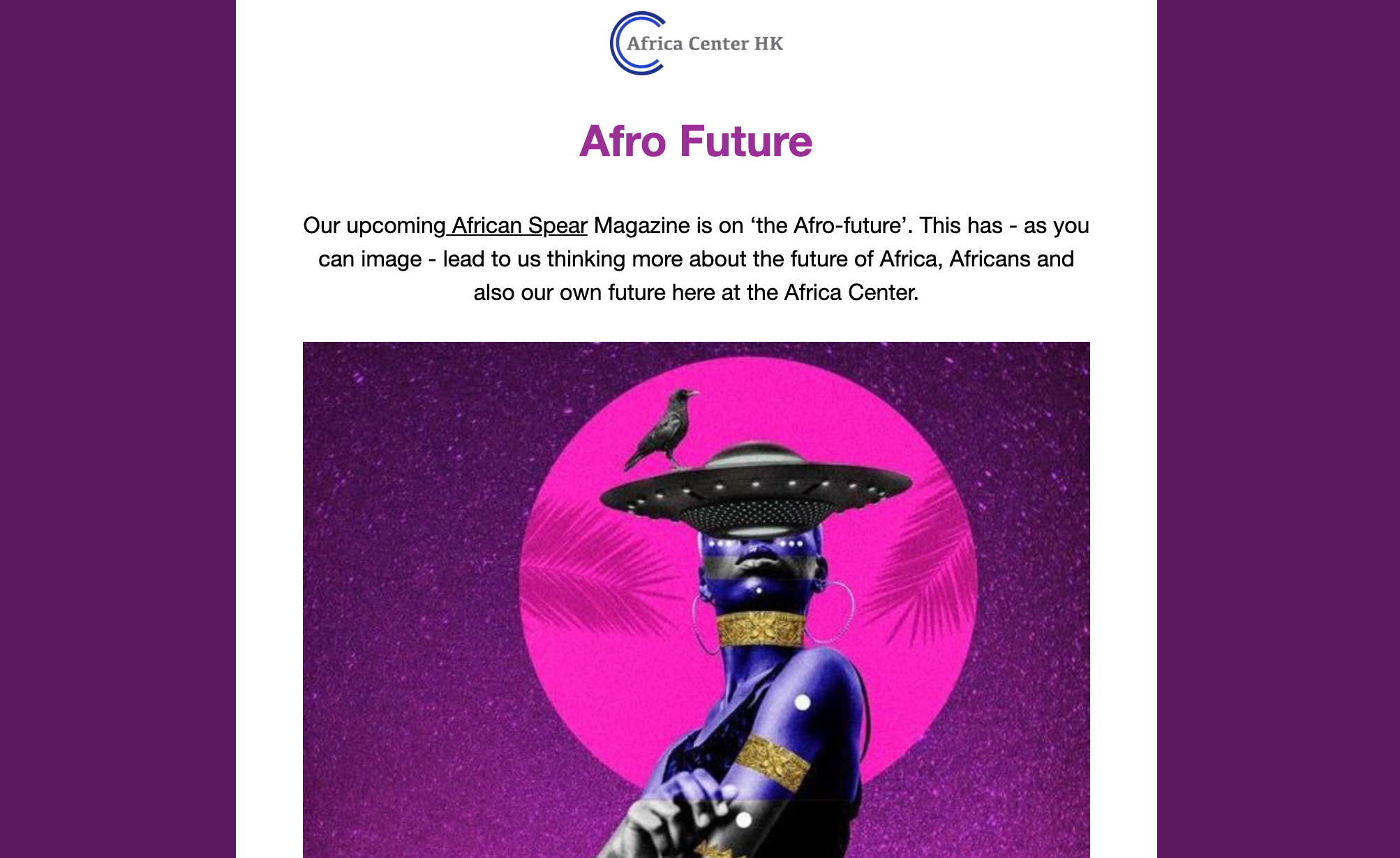
The most popular example of Afrofuturism at the moment is probably the Marvel movie Black Panther. Other examples of Afrofuturism that may come to mind are images like the one above or science fiction novels that are based on the African continent. This is because Afrofuturism by definition encompasses: ‘a philosophy of science, aesthetic and history that explores the developing intersection of African culture with technology.’

Using this definition it is clear to see how Afrofuturism can often have nothing at all to do with the African continent as it necessitates a link with technology – which in and of itself is often thought to originate only from the western world. For example, a main theme in Afrofuturistic art is space – many artists will use imagery such as the moon, spaceships or stars to depict they vision of Afrofuturism. This is despite the fact that out of 55 African countries only 8 – Kenya, Ghana, Morocco, Egypt, Algeria, Nigeria, South Africa and Angola – have space programs at all. Zambia is notably missing on this list despite the efforts of Edward Mukuka Nkoloso.

Find out more about the African Space Industry

What we are trying to say by this is that there needs to be a future imagination of the African continent that does not aspire to western standards of technology and more than that there needs to be a consideration of what constitutes as technology and the ills of technology as we know it today. This is why we went for the term Afro-future instead of sticking to Afrofuturism.

African Spear

Mashona women in the early 1900`s.

We could not help but noticing how these regal maShona women and children from present day Zimbabwe seem to have inspired many Afrofuturistic artists, from the copper chokers and bracelets to the short hair and bold poses – we just wanted to share that with you!

We mentioned at the start of this newsletter that this topic has made us think about the future of the Africa Center in Hong Kong. For us, we see it as us becoming more and more of a community center for Africans in the city and an expanding hub for growth and interactions between Africans and non-Africans.


This email was sent to *|EMAIL|*
why did I get this?    unsubscribe from this list    update subscription preferences
*|LIST:ADDRESSLINE|*

*|REWARDS|*

Our Hairstory (Oct 2021)

*|MC:SUBJECT|*
Logo

Our Hairstory

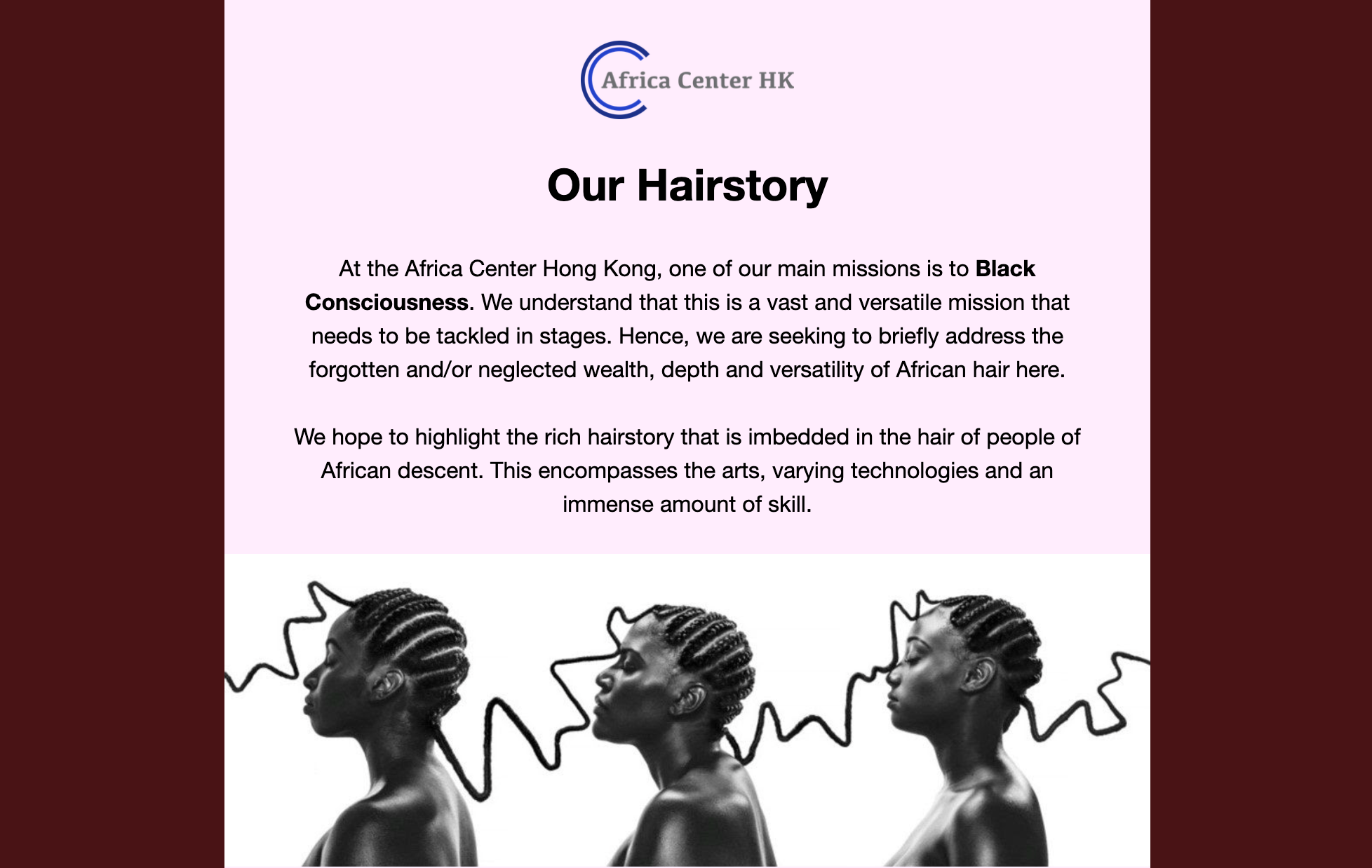
At the Africa Center Hong Kong, one of our main missions is to Black Consciousness. We understand that this is a vast and versatile mission that needs to be tackled in stages. Hence, we are seeking to briefly address the forgotten and/or neglected wealth, depth and versatility of African hair here.
We hope to highlight the rich hairstory that is imbedded in the hair of people of African descent. This encompasses the arts, varying technologies and an immense amount of skill.

Image by Shani Crowe: The Breadth We All Share

When we look at afro textured hair, we see intricate styles that are plated on or across the scalp. We see works of art carried on a head sometimes with the incorporation of adornments like shells and beads. Many times too we see the enhancement of afro textured hair through wool or hair extensions that bring new shapes to life on the heads of black people. Even the supposedly simple style of the Afro, is a work of art that not everyone can execute.

Image of Asahti warriors (Ghana) early 20th century

Black people have a rich hairstory which encompasses hairstyles that were used as means of protection by for example hiding gold and messages in plated hair; hair that was plated to show a map or communicate messages to those who knew what to look for; or the carrying of certain hairstyles as political statements, such as the Afro’s of the black panthers and the rastas of the Rastafarians.

Why is black hair so political?

We at the Africa Center understand that hair has always been a social experience that in caring for it but also in the styles that a person may choose to carry that can tell us many things about the person. However, for people with Afro-textured hair especially, this experience has unfortunately become deeply political too through years of colonialism and imperialism that deigned afro textured hair as undesirable.

For this reason we think that it is of importance to share our hairstory not only with foreigners but also amongst ourselves as we have often been denied access to this hairstory.

More Information

On sharing more about our heritage and recording our histories:
Prof. Jette G. Hansen Edwards is looking for speakers of African languages in Hong Kong for a project on language diversity. If you are interested in joining the project, please email her at jhansen@cuhk.edu.hk. Interested speakers would be audio recorded reading aloud simple words and sentences as well as responding to questions about their language. It would take around 1 hour and you would be paid 100HKD in cash for your time. Parts of the recorded data would be shared publicly on a website on linguistic diversity (names and other identifying information would be withheld).

Click here for more information on Prof.Hansen Edwards’ research


This email was sent to *|EMAIL|*
why did I get this?    unsubscribe from this list    update subscription preferences
*|LIST:ADDRESSLINE|*

*|REWARDS|*

Afro Asian Fusion (Sep 2021)

*|MC:SUBJECT|*
Logo

Afro Asian Fusion

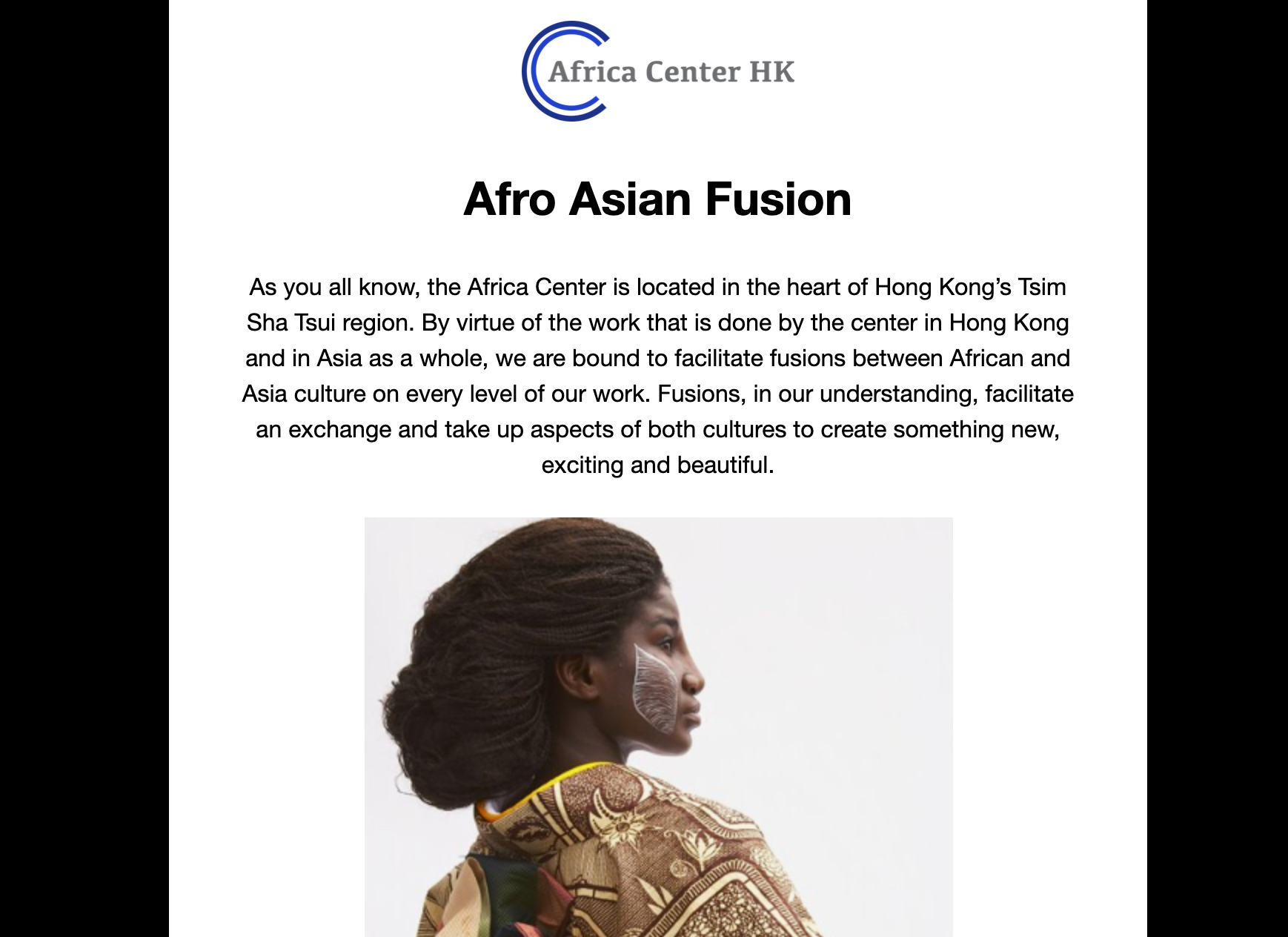
As you all know, the Africa Center is located in the heart of Hong Kong’s Tsim Sha Tsui region. By virtue of the work that is done by the center in Hong Kong and in Asia as a whole, we are bound to facilitate fusions between African and Asia culture on every level of our work. Fusions, in our understanding, facilitate an exchange and take up aspects of both cultures to create something new, exciting and beautiful.

We recently had a group of university students come to the Africa Center and exchange ideas with our team for an upcoming service learning project. One student who is originally from Hong Kong, suggested that we create events at the Center that help Africans and other ethnic minorities learn more about the culture of Hong Kong. Although, we believe that our community has ample chance to be in contact with Hong Kong culture in the city, the suggestion did show us that even this local student, felt free and open to share something as personal as her culture in the space we have created. This for us is the first step to creating a meaningful exchange and fusion.

Connecting Communities

One of our core values is Connecting Communities both on a practical and ideological level. To nature this value we have created many programmes where an exchange is facilitated.

Afro Asian Fusion

The latest of these programmes is the Afro Asian Dinner that gives your taste buds the best of both worlds and something extra! These dinners bring Africans and Asians together not only in the physical space but also in the sharing of foods.

Afro Asian Fusion Dinner

Reading Corner

For this months book club we will be reading the thought provoking The Wretched of the Earth by Frantz Fanon. As always, the book club is open to all and no prior registration is required.

African Literature Book Club

Looking for something to do over the long weekend?

Check out our upcoming events for fun and exciting activities for the upcoming long weekend.

Upcoming Events
Facebook iconInstagram iconWebsite iconYouTube iconLinkedIn icon
Logo

Copyright (C) 2021. Africa Center Hong Kong. All rights reserved.

Want to change how you receive these emails?
You can update your preferences or unsubscribe


This email was sent to *|EMAIL|*
why did I get this?    unsubscribe from this list    update subscription preferences
*|LIST:ADDRESSLINE|*

*|REWARDS|*

How big is Africa really? (Sep 2021)

*|MC:SUBJECT|*
Logo

The real size of Africa

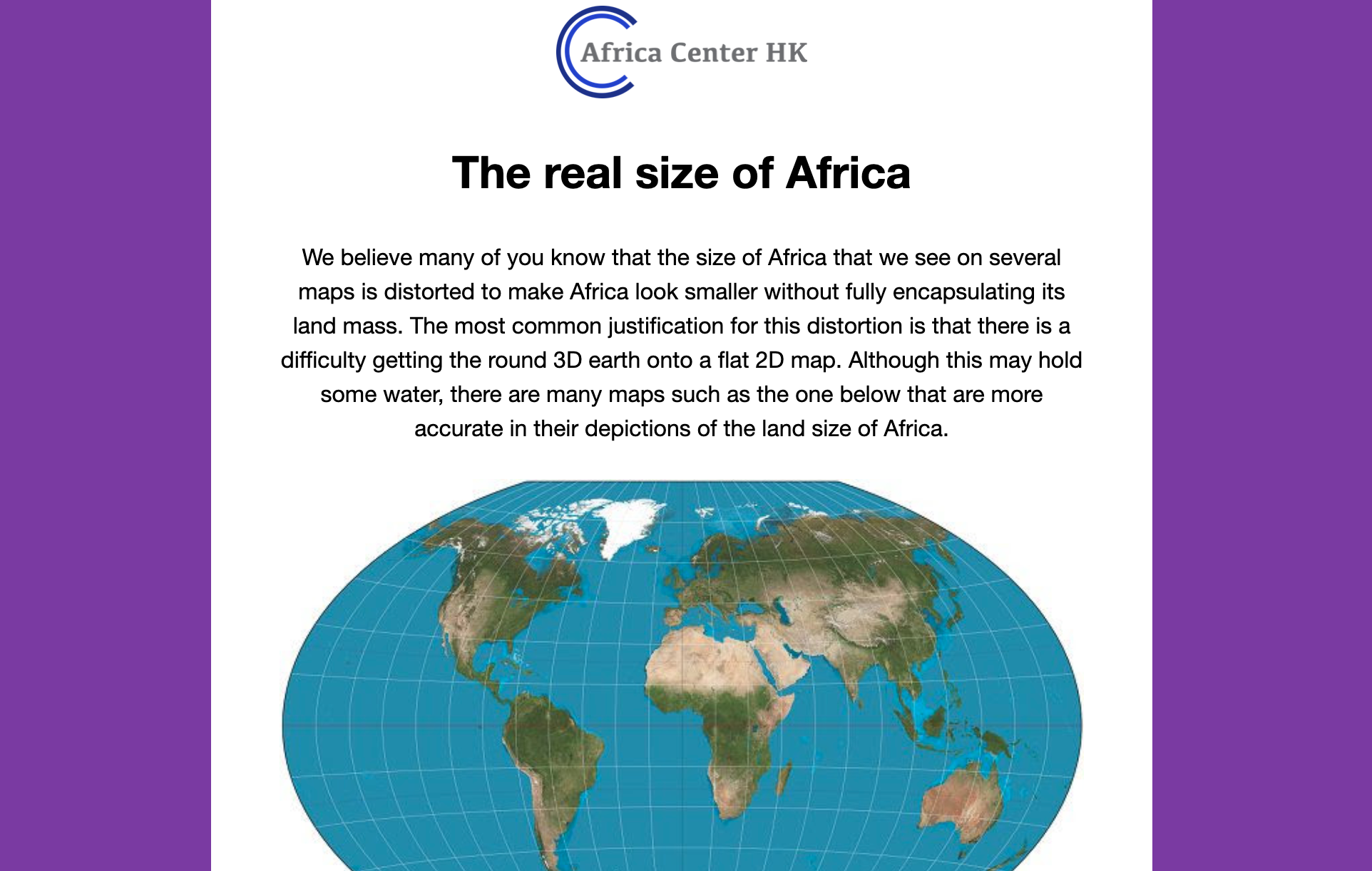
We believe many of you know that the size of Africa that we see on several maps is distorted to make Africa look smaller without fully encapsulating its land mass. The most common justification for this distortion is that there is a difficulty getting the round 3D earth onto a flat 2D map. Although this may hold some water, there are many maps such as the one below that are more accurate in their depictions of the land size of Africa.
Learn More

Maps are important because they assist in the navigation of the world and they also show us what things are valued and what things are seen as unimportant. Due to colonisation of curriculums, education, script and maps, people have continued to use maps that reduce the size and the relevance of Africa on a global scale. We believe that the time has come to change our lens and to focus on the true capacities of Africans influenced by the mere landmass our continent takes up in this world. This is one of our goals at the Africa Center in which we want to emphasise Black Consciousness and highlight the greatness of Africa and its people. The bigger the better!

Find out more about our work here

Zambian Election

On the 12th of August 2021 Hakainde Hichilema of the United Party for National Development (UPND) was democratically elected as the new president of Zambia. We are excited to see what this leader will do for the country. We believe that this is a great step for Zambia. Congratulations!

Learn More

African Students Nite

Locally, we are planning a students nite for all the African students and their friends who want to meet and create more of a community in the city. Registration is still open to all those interested! The event will be held on Friday the 10th of September 2021.

Join us!

As always we have many exciting events lined up for you at the Africa Center Hong Kong, here is the heart of Tsim Sha Tsui. Feel free to pass by! One such event is the African Literatures Book Club.

Book Club

Our book club that meets every three to four weeks is in full swing with our next book in three weeks time. We will be reading ‘The Wretched of the Earth’ by Frantz Fanon. That gives you enough time to read and join us!

Find out more!
Facebook iconInstagram iconWebsite iconYouTube iconLinkedIn icon
Logo

Copyright (C) Africa Center Hong Kong 2021 All rights reserved.

Our mailing address is:
africacenter.hongkong@gmail.com

Want to change how you receive these emails?
You can update your preferences or unsubscribe


This email was sent to *|EMAIL|*
why did I get this?    unsubscribe from this list    update subscription preferences
*|LIST:ADDRESSLINE|*

*|REWARDS|*

The African Spear (Aug 2021)

*|MC:SUBJECT|*
Logo

African Spear Magazine

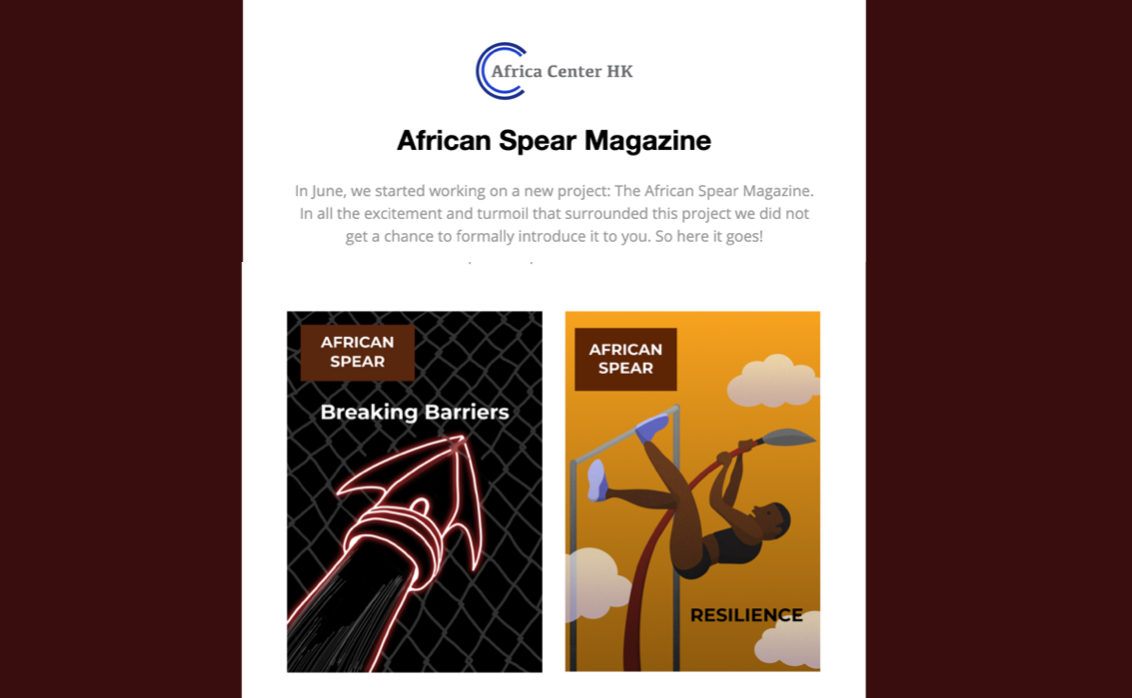
In June, we started working on a new project: The African Spear Magazine. In all the excitement and turmoil that surrounded this project we did not get a chance to formally introduce it to you. So here it goes!
The African Spear is a magazine that is here to show and celebrate the presence of people of African descent in the Hong Kong. Just like a spear it is sharp and precise, and just like the spear it is wielded by strength and power. In the magazine we always take on a topic and through different contributors we paint a diverse image of this topic through articles, poems and artworks! Our past topics for this new project have been Migration and Resilience. Watch out for our next issue on Heritage coming out soon!

The magazine is available as both a hard and soft copies. The hard copies can be purchased at the Africa Center in Tsim Sha Tsui whilst the soft copies can purchased online.

Buy our latest issue here!

As a mouthpiece for the African community in Hong Kong, the African Spear addresses topics of interest for our communities in the city, in Asia and beyond.

Afghanistan.

Currently, a topic that is lying very close to our heart is the effects of colonialism and imperialism being played out on the land and bodies of Afghanistan and Afghans. We ask people of Hong Kong to stay informed on the issue, to discuss and educate themselves of the situation.

Image by @amirmansour (click on the image to view more of the artists work)

Learn More

Upcoming Events

We have many events lined up for you in the next week. Tomorrow (18.08) we have our monthly book club meeting were we will be discussing the classic novel by Buchi Emecheta called The Joys of Motherhood. For all those who want to relax and do something new on Saturday be sure to join our Zorora Art Jam where you can paint and listen to some chilled music. Next week (25.08) we will be hosting an event on ‘Queer Narratives of Africa’ that will explore what it means to be queer on the African continent. Check out all of our upcoming events!

Upcoming Events

Eritrean & Ethiopian Culinary Experience

We have added a new and exciting dining experience to our catalogue. Join us to taste the divine cuisine of Ethiopia and Eritrea in a private dining experience!

Learn More
Facebook iconInstagram iconWebsite iconYouTube iconLinkedIn icon
Logo

Copyright (C) 2021. Africa Center Hong Kong. All rights reserved.

Our mailing address is:
africacenter.hongkong@gmail.com

Want to change how you receive these emails?
You can update your preferences or unsubscribe


This email was sent to *|EMAIL|*
why did I get this?    unsubscribe from this list    update subscription preferences
*|LIST:ADDRESSLINE|*

*|REWARDS|*

Lessons from the Summer Camp (Jul 2021)

*|MC:SUBJECT|*
Logo

Lessons from the Summer Camp

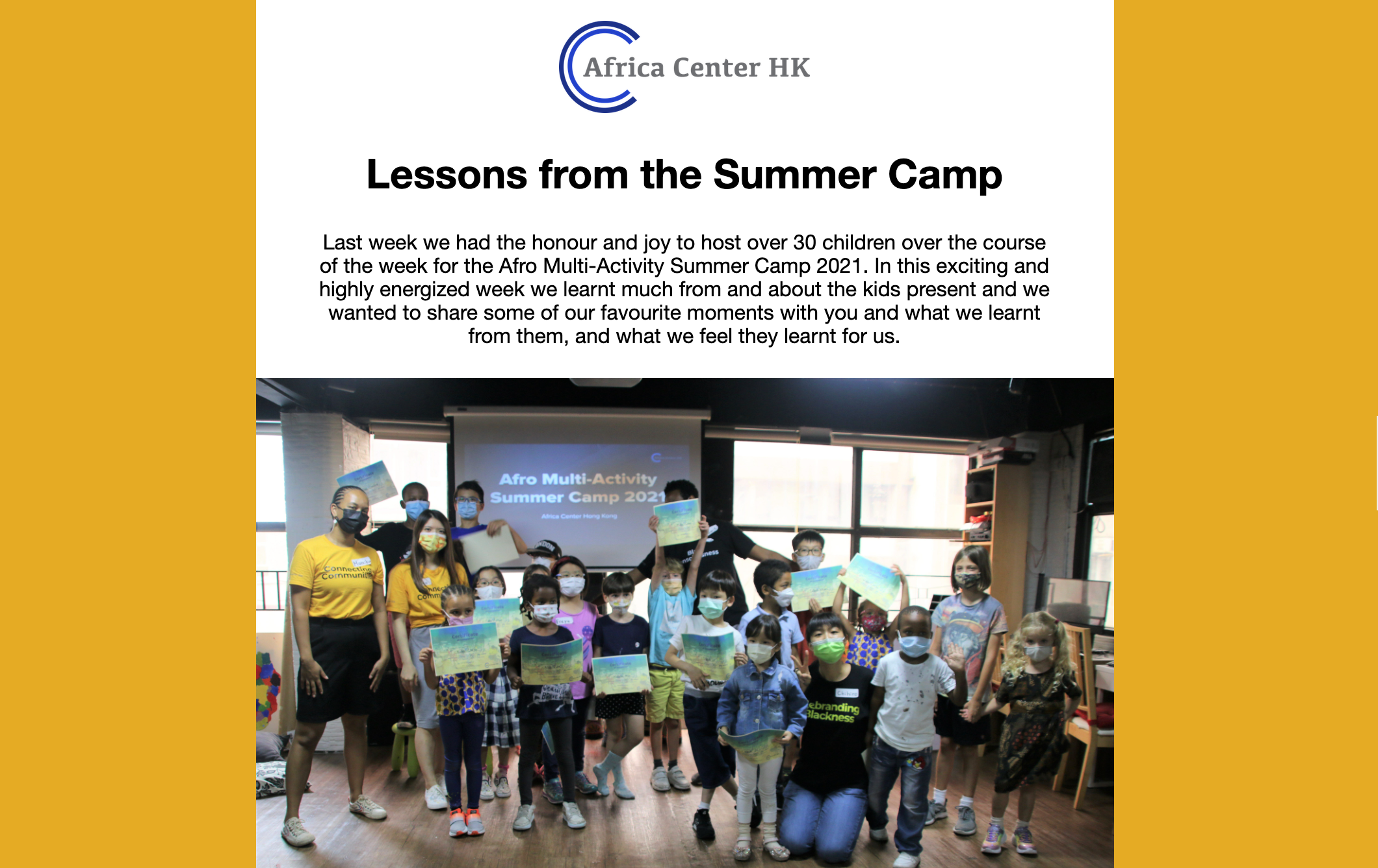
Last week we had the honour and joy to host over 30 children over the course of the week for the Afro Multi-Activity Summer Camp 2021. In this exciting and highly energized week we learnt much from and about the kids present and we wanted to share some of our favourite moments with you and what we learnt from them, and what we feel they learnt for us.
‘Do you regret being in Hong Kong?’

During a passionate presentation by one of our project managers, Dawit – who was born and raised in Eritrea – on the geography of the African continent, a child asked if he regretted being in Hong Kong. She showed genuine concern in her questioning as she saw that for Dawit, the African continent was a wonderful place to be. We believe that there have been many negative images that have been painted of the continent and moments like these are important to remind children and ourselves that we are constantly seeing a skewed image of Africa that is far from the realities of all the continent has to offer. Through her question we saw that for this girl, Africa too had become a beautiful place that one would regret leaving.

Food, Food, Food

On the third day of the camp the children had the chance to make their own food. They baked Mbatata cookies (Malawian) and Chimodho cake (Zimbabwean). We were impressed and pleased with the motivation the children had both to prepare and eat foods that they said were uncommon to them. Many enjoyed this food and the lunch food spanning across cuisines from the African continent and the African diaspora. Through the food then they learnt of the diversity and richness of African cultures.

Mbatata Cookies Recipe

Playing Pada

Playing pada was an important part of the childhood of one of our team members, Charleen, who grew up playing this game with friends. For her, being able to see this game passed on to different children at the Center and the joy and competition that they derived from this was something that brought memories to her. We believe that we can teach children about African cultures not only by telling them but also by showing and playing with them as this is also a method of recording histories. Through our playground that taught the children different games played in different places on the continent we managed to share a part of our cultures that we believe the children will remeber and hopefull pass on too.

African Kidz Club

If you missed the summer camp do not worry, you can still get a taste of it at our African Kidz Club held every last Saturday of the month, the next one coming up this weekend.

Learn More
Facebook iconInstagram iconWebsite iconEmail iconYouTube iconLinkedIn icon
Logo

Copyright (C)2021. Africa Center Hong Kong. All rights reserved.

Our mailing address is:
africacenter.hongkong@gmail.com

Want to change how you receive these emails?
You can update your preferences or unsubscribe


This email was sent to *|EMAIL|*
why did I get this?    unsubscribe from this list    update subscription preferences
*|LIST:ADDRESSLINE|*

*|REWARDS|*

Education Is Key? (Jul 2021)

*|MC:SUBJECT|*
Logo

Education is key?

The phrase ‘education is key’ is constantly evoked, especially when talking about ‘solving the problems’ of Africa. This education is institutional (that is it is found in schools and universities) and it is something that is expected to be given to children, making them more responsible and useful citizens. We of course believe in the power of education here at the Africa Center, however, more than that we believe that a reflection on what kind of education the children in our community are receiving is paramount.

Institutional Education

Most (but not all!) of the schools that exist today on the African continent are remnants of colonial institutions that either were designed to accommodate the colonizer, or that were designed to keep colonised peoples in a lesser social, economical and political position. What then does it mean that we have taken on these systems, often without changing much, and continue to use these schooling systems? It means that the system of education that is being used is not designed to enable the growth of the community/society or country.

Rhodes Must Fall

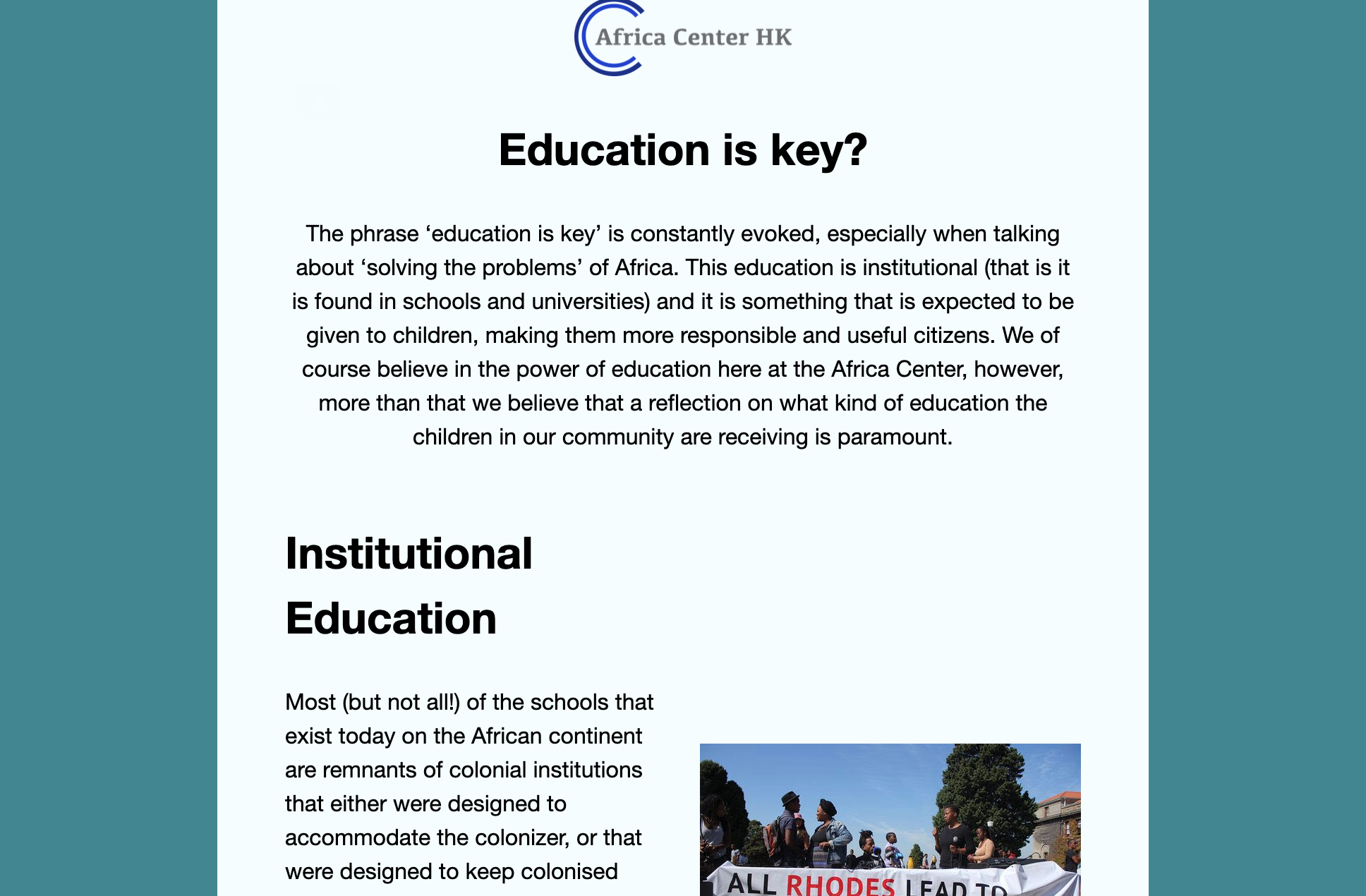
Many of you will have heard of the Rhodes Must Fall protests that were staged by South African students, followed by students all over the world, starting on the 9th of March 2015. This protest in which students called for the decolonisation of the education curriculum showed clearly that the colonial regime still had its grip on institutional education. Moreover, it showed the massive adverse effects this had on the majority black students receiving this education.

Learn More

So friends, returning to the idea of education as key, we must think of what education we are thinking about and making sure that this education is not further perpetrating the ills that we are trying to fight, colonial or not. Patrick Mpedzisi, a civic and social organization consultant in Zimbabwe, talked once of ‘knowledge dissemination’ as a way of spreading information and knowledge that moves away from the idea that institutional education has a monopoly on knowledge. This is something that we at the Africa Center believe in too and want to share with the children in our community.

Afro Multi-Activity Summer Camp!

What better way would there be to share knowledge with children in our community here in Hong Kong than through a summer camp? Moving away from the formal setting of institutional education we share knowledge with children on various topics. From dance, to drama from drumming to mask making and storytelling – the Afro Multi-Activity Summer Camp is going to be a fun and exciting learning experience for children!

Afro Multi-Activity Summer Camp 2021
Learn more!

Reading Corner

We have been reading ‘The House of Hunger’ by Dambudzo Marechera. Marechera has a interesting history with institutional colonial education as he learnt at a one of the first secondary schools to allow black students admission in Zimbabwe. Come and join us as we discuss this eccentric author!

Book Club
Facebook iconInstagram iconWebsite iconYouTube iconLinkedIn icon
Logo

2021. Africa Center Hong Kong. All rights reserved.


Our mailing address is:
africacenter.hongkong@gmail.com

Want to change how you receive these emails?
You can update your preferences or unsubscribe


This email was sent to *|EMAIL|*
why did I get this?    unsubscribe from this list    update subscription preferences
*|LIST:ADDRESSLINE|*

*|REWARDS|*

Juneteenth (Jun 2021)

*|MC:SUBJECT|*

Juneteenth

This past weekend, on the 19th of June Black people across the globe celebrated Juneteenth. So what really is Juneteenth about?

The word Juneteenth is a bled of the word June and nineteenth. It celebrates the abolition of slavery under the 1863 Emancipation Proclamation under president Lincoln. The 19th of June 1865 was the day that this proclamation was belatedly announced in Texas.

Picture of Juneteenth celebrations in Virginia circa 1905

New York Times Article: What is Juneteenth?

As seen in the picture above, black people in the USA have been celebrating this day ever since the abolition of slavery. So the question arises why people, in for example Hong Kong, are only hearing of this holiday for the first time this year.

2020 was a memorable year, to say the least. The murder of George Floyd by Derik Chauvin, a policeman at the time, sparked global protests against the institutional racism in the United States and the violence of the policing system. These protests brought attention to many of the injustices that black people are still living with in the USA today that are remnants of slavery and imperialism. In light of this Juneteenth also gained more public exposure and was finally officially recognised as a public holiday. This is probably why more and more people are hearing about the day now.

So what significance does Juneteenth have outside of the USA?
For black people all over the globe the history of the transatlantic slave trade has been an integral part of our histories. Whether this was in the form of having ancestors stolen from the continent, or whether it was through the sustaining of the ideology of white supremacy that was used to justify the atrocities of imperialism and colonialism. Hence, Juneteenth for us at the Africa Center is a celebration of the emancipation of our black siblings and a marker against the fight against white imperialism. This is why we celebrate.

Despite countless obstacles faced by Black people in the US, they built, they created, they persevered, and this should be rejoiced.

Edna Bonhomme, 2021

Chisingaperi chinoshura.

Shona Proverb meaning ‘all things come to an end’

In its essence, Juneteenth celebrates a day that for many enslaved people was impossible to even imagine. It celebrates the fact that all things come to end as the proverb above says. In this way it reminds black people all over the world that the oppression and racism we are faced with today will also come to an end. Juneteenth in its essence is a marker of a collective past and a hope for a better and just future.

If you are interested to know more about the experiences and celebrations of African Americans you can join us for our event series ‘U.S. Race Relations 101’ happening on the 4th of July.

US Race Relations 101
Facebook iconInstagram iconWebsite iconYouTube icon
Logo

Copyright (C) *|2021|* *|Africa Center Hong Kong|*. All rights reserved.

Our mailing address is:
*|africacenter.hongkong@gmail.com|*

Want to change how you receive these emails?
You can update your preferences or unsubscribe


This email was sent to *|EMAIL|*
why did I get this?    unsubscribe from this list    update subscription preferences
*|LIST:ADDRESSLINE|*

*|REWARDS|*